

Minnesota Elevation Mapping Project
 The goal of this project
was to develop and deliver a seamless
high-accuracy digital elevation map of the State of Minnesota, based on data
collected using LiDAR technology. Accurate topographic information will greatly enhance the ability of
decision makers and resource managers to understand how water interacts with
the landscape and will provide the foundation for developing innovative,
effective, and defendable resource management strategies. The project
will facilitate the flow of data between all levels of government: local,
state, and federal.
The goal of this project
was to develop and deliver a seamless
high-accuracy digital elevation map of the State of Minnesota, based on data
collected using LiDAR technology. Accurate topographic information will greatly enhance the ability of
decision makers and resource managers to understand how water interacts with
the landscape and will provide the foundation for developing innovative,
effective, and defendable resource management strategies. The project
will facilitate the flow of data between all levels of government: local,
state, and federal.
In July 2009, the Minnesota Legislature appropriated $8.3 million ($2.8 million each in fiscal years 2010 and 2011; $1.35 million each in fiscal years 2012 and 2013) from the Clean Water Fund of the Clean Water, Land and Legacy Amendment to help realize the goal of creating a seamless elevation model for Minnesota by filling in the areas where data either did not exist or was deemed to be old enough to be replaced. The project was coordinated by MnGeo's Digital Elevation Committee.
On October 2, 2014, the project received a
Governor's
Geospatial Commendation Award.
Data Availability | Project Schedule |
Product Deliverables |
Vertical Accuracy |
Master
Contract | Partnerships
| Articles/Meeting Materials |
Steering Team |
Questions/Feedback
Data Availability
-
See the LiDAR Elevation
Data for Minnesota webpage for:
- Data download options
- Help and training info
Project Schedule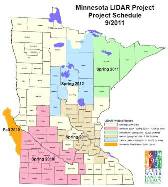
Project Area Map The total project area, encompassing 45,349 square miles across 47 counties, was split into five phases as shown on this map.
Flight lines and dates of acquisition for the
project:
KMZ file for Google Earth and
shapefile
Phase 1 - Minnesota River Basin, Minnesota Portion, Spring
and Fall 2010
The area included 17,260 square miles in 25 counties
in southwestern Minnesota
including Brown, Chippewa, Cottonwood, Douglas, Faribault, Jackson,
Kandiyohi, Lac qui Parle, Le Sueur, Lincoln, Lyon, Martin, Murray, Nicollet,
Nobles, Pipestone, Pope, Redwood, Renville, Rock, Sibley, Swift, Waseca,
Watonwan and Yellow Medicine.
80% of the project area was flown April 8th – May 5th, 2010; the remainder of the project area was completed in November 2010.
Phase 2 - Minnesota River Basin, South Dakota Portion, Fall
2010
The U.S. Geological Survey contributed
funding for this phase - see
graphic.
Phase 3 - Arrowhead Region, Spring 2011
Covers 4 counties: Carlton, Cook, Lake and St. Louis, part of
Itasca County and Voyageurs National Park in Koochiching County. Two
pilot project areas – one encompassing Vermillion State Park and one
capturing the west portion of Duluth – were also collected.
- Documentation
- Map showing block boundaries
- Map of point densities
Phase 4 - Twin Cities Metro Area in Central Minnesota, Spring and Fall 2011
Covered 15 counties:
Anoka, Benton, Carver, Dakota, Goodhue, Hennepin, Isanti, Kanabec, Meeker, Mille Lacs,
Morrison, Ramsey, Scott, Sherburne and Washington.
- Documentation
- Map showing block boundaries
Phase 5 - Central Lakes Region, Spring 2012
Covered 6 complete counties in north-central Minnesota: Aitkin,
Cass, Hubbard, Itasca, Todd and Wadena, along with a portion of
Koochiching County.
- Documentation
-
Map
showing block boundaries.
Product Deliverables
The Digital Elevation Committee defined the products to be delivered and the data collection, processing and accuracy standards to be followed.
The standards were based on the USGS Base LiDAR Specification and included:
- Mean Post Spacing = 1.5 meters (first return)
- <=15 centimeter RMSEz, 2-foot vertical accuracy (95% confidence)
- 1 meter horizontal accuracy
- Tiling scheme is 1:24,000 quarter-quarter quads (1/16 quad) – an area of 3.25 square miles
Products to be delivered included:
- Classified LAS format files
- Bare Earth
- Vegetation
- Buildings
- Water
- Edge-of-water breaklines for ponds and rivers
- One-meter raster DEM, hydro-flattened using breaklines
- 2-foot contours (to be created by project team)
- Building footprint polygons: A process to create rough building footprint polygons from the points in the LAS data that are classified as buildings (LAS Code 6) has been developed.
Coordinate system:
- UTM Zone 15, NAD83 horizontal datum, NAVD88 vertical datum
- Vertical units in meters
Vertical Accuracy of Delivered Data
Consolidated
Vertical Accuracy (CVA) Map, December 2012

This map shows the Root Mean Square Error (RMSE) by county or acquisition
data block, as well as the acquisition year for each project area.
Consolidated Vertical Accuracy is the RMSE of all the test data -- more than 100 validation points per county -- in all five major cover types: Urban, Open, Brush, Forested and Tall Grass. (In contrast, Fundamental Vertical Accuracy is just the test data in the Open Terrain category.)
The State of Minnesota LiDAR dataset was not all collected at one time or under one project. Although LiDAR data had been collected prior to 2007, it was felt that those datasets that were acquired following the USGS LiDAR Guidelines and Base Specifications would determine if an existing dataset would be part of the statewide dataset.
The Minnesota DNR was the lead agency for this project but we must
acknowledge the contributions of the International Water Institute, Fargo,
ND and the various Minnesota counties who negotiated the release of their
data for this public purpose. See Partnerships section below for more info.
Project Master Contract
The State of Minnesota created a Master Contract for LiDAR Services that was in effect for three years, expiring July 1, 2012 (except for the work in progress). The contract provided a way to pre-qualify LiDAR vendors and then have them on a retainer for future work orders. The Master Contract was also available for other units of government to utilize for special projects. The Master Contract vendors were:
- Aero-Metric Inc.
- Fugro/Horizons
- Sanborn
- Woolpert
Partnerships
The project team received valuable in-kind assistance from local units of government, primarily county surveyor staff, to collect high accuracy survey points that were used by the project team to validate the data. These points were crucial to ensure that the data delivered by the vendor met the accuracy requirements agreed upon in the work order contracts. A structured process for collecting validation points ensured that they were comparable across the region.
- Validation
point status
- Arrowhead region complete
- Metro region complete
- Central Lakes region complete
Articles and Meeting Materials
Articles
-
Project announcement and overview: Mn GIS/LIS News, Fall 2009
Meeting Materials
- January 13, 2010: St. Paul
- Project description slides (17 slides, 3.2 MB, PPTX)
- Survey test data points slides (7 slides, 2.2 MB, PPT)
- September 24, 2009: Willmar, Marshall,
Worthington, Mankato
- Announcement
- Project brochure
-
Presentation slides (32 slides, 10.8 MB, PPT)
Steering Team
- Project Manager, Tim Loesch – Minnesota Department of Natural Resources
- Chris Cialek – Minnesota Geospatial Information Office, coordination and technical reviewer
- Les Everett – University of Minnesota, Center for Water Resources, project advisor
- Pete Jenkins – Minnesota Department of Transportation, survey and validation coordinator
- Shelly Sentyrz – Minnesota Department of Natural Resources, LiDAR and elevation technical resource
- Ron Wencl – USGS MN
Spatial Data Liaison, coordination and technical reviewer
Questions and Feedback
For more information on the project, please contact MnGeo at:
gisinfo.mngeo@state.mn.us
Return to Digital Elevation Committee page